
Worker exposure to dangerous chemicals at Rubicon plant in Geismar linked to poor maintenance record | Environment
Ryan Housley had just finished repairing a pipeline inside one of the manufacturing units on Rubicon LLC’s 81-acre campus in Geismar when his shift ended on a stifling hot afternoon in May 2012.
As he did on many weekdays, he headed for class at ITI Technical College in Baton Rouge, 18 miles away.
But when Housley arrived, Rubicon environmental manager Michelle Eaglin later told the Louisiana State Police, people told him he looked “grayish and sick.”
Housley, an employee of Turner Engineering assigned to the Rubicon site, quickly returned to Geismar. Medical personnel at Rubicon’s first-aid center quickly diagnosed the problem: He had been exposed to aniline, a toxic chemical used to make plastics. It was causing oxygen levels in his blood to drop to dangerous levels.
The result was a medical condition called methemoglobinemia. Aniline had changed the hemoglobin in Housley’s blood – which carries oxygen to the cells – into methemoglobin, which won’t carry oxygen.
Even a small amount of methemoglobin in your blood can block the uptake of oxygen and turn the skin bluish.
Rubicon’s first responders realized the cause of his pallor, and they rushed him to nearby St. Elizabeth Hospital, now Our Lady of the Lake Ascension Hospital. There, his methemoglobin level was measured at a life-threatening 27%. Quick treatment dropped it to a safe 3% the next day, and Housley was released and declared fit to return to work.
Today, Housley is a planner with the Texas-based manufacturer Huntsman Corp., the co-owner of Rubicon, with Germany-based chemical giant LANXESS Corp. He did not respond to requests to be interviewed for this story.
After the incident, Rubicon officials, as required, immediately notified the Louisiana State Police, which operates an emergency hotline for industry accidents.
They also alerted the Ascension Parish Sheriff’s Office and the state Department of Environmental Quality, even though the company estimated that no more than a pound of aniline had been released, far less than the reportable quantity of that chemical under federal and state rules. None of the material left the Rubicon property, the company said.
The 2012 incident was one of 25 in the past decade where leaks of dangerous chemicals on the Rubicon campus exposed workers there or nearby.
In those 25 releases, a total of 130 workers reported to on-site first-aid stations for observation or treatment because of their exposures, with 22 workers treated offsite — most at St. Elizabeth, according to the DEQ’s files.
Those files also show the company has a long track record of safety violations and chronic failures to maintain pipelines and other crucial equipment — failures that have elicited little in the way of fines or other penalties from DEQ’s regulators.
This article was produced in partnership with The Times-Picayune and The Advocate, which are members of the ProPublica Local Reporting Network.
It’s hard to say whether Rubicon’s history makes it an outlier among Louisiana manufacturers. While records of all dangerous chemical leaks are stored at the DEQ, the agency’s database is organized in a way that makes comparisons between different facilities extremely difficult. Each year, roughly 2,000 reports on air-quality “incidents” — some emergencies, some not — are filed into DEQ’s database.
The DEQ database included 75 air-quality incident reports for Rubicon in 2019, which compares to 78 such reports for BASF, 67 for Westlake Vinyls, and 47 for Nova Chemicals, formerly Williams Olefins, all in Geismar.
Indeed, releases of small amounts of toxic chemicals into the air are so common that the DEQ created a special task force to deal with the way companies notify state agencies about them. The new guidelines allow initial conservative, higher estimates of the amount of chemicals released to be adjusted after more careful reviews end up concluding that the releases were actually below reportable amounts.
But the repeated exposure of workers — and the potential for exposure of the public — should prompt federal and state regulators to mete out stiffer punishments, said Eric Schaeffer, the former EPA enforcement chief who is now director of the Environmental Integrity Project, an activist group.
“It should be a reflexive response that they be required to pay” each time there’s a toxic release, Schaeffer said. “Even if it’s $200,000 or $300,000, and you can do it quickly … and the next time it’s $500,000, and the next time it’s $1 million, it would shake up the system and get more response from these facilities.”
The exposures that Rubicon has reported involved many hazardous chemicals used or manufactured at its Geismar plant, including ammonia, aniline, benzene, chlorobenzene, diphenylamine, hydrochloric acid, methylene diphenyl diisocyanate, nitric acid, nitrobenzene, phosgene and sulfuric acid.
Some of those chemicals, such as benzene, are known to cause cancer. Others, like hydrochloric and sulfuric acid, pose a danger from burning. And still others, such as aniline, nitrobenzene and phosgene, are poisonous.
ProPublica is a nonprofit newsroom that investigates abuses of power. Sign up to receive our biggest stories as soon as they’re published.
Rubicon handles a broad range of chemicals because they are used in the manufacture of plastics and are sold to other companies. It is not alone among petrochemical companies along the Mississippi River and in the Lake Charles area in handling a wide variety of dangerous materials.
Rubicon officials point out that its facility has a low official rate of reportable injuries as measured by the federal Occupational Safety and Health Administration. That agency gives Rubicon an annual rate of just 0.40 injuries per 100 full-time employees, which compares to an average rate in 2016 of 1.7 for all chemical manufacturers of similar sizes.
Officials also point out that the company has been certified a “Star Safety Site” under OSHA’s voluntary protection program.
But how much that means is hard to say. In response to a federal Freedom of Information request, officials with OSHA said no records exist showing the agency has ever conducted an inspection or taken any regulatory action involving the Rubicon facility, including for the exposures that led to more than 100 workers needing medical attention.
DEQ officials said worker-safety issues from such releases are the responsibility of OSHA.
However, if any company believes an incident is an emergency, it is still required to notify the State Police hotline and the DEQ within an hour.
And it’s required to file a more formal report within 24 hours for any accident that results in a chemical release. If the release is a reportable quantity, or the incident must be reported for another reason, the company must also file a follow-up report within seven days.
There are other triggers for a second report: The facility or its neighbors were ordered to “shelter in place,” or chemicals left the site and caused road closures.
That second report is required to detail what caused the release, what happened when it occurred — including the company’s initial responses — and any long-term actions aimed at preventing a repeat.
The DEQ assigns inspectors to investigate and follow up on those reports. While that can mean a site visit, it typically entails a review of the reports sent in by the company and follow-up questions by phone or email.
“We look at the information that they send us,” said Michael Algero, administrator of DEQ’s surveillance division. “If the releases are either preventable or operator error — or, based on the information that they provide to us, we deem it was preventable or operator error — those are referred to our enforcement division for follow-up action.”
He said that level of response typically applies to incidents where a reportable quantity of chemicals was released or an emergency was declared by company officials.
“But we do look at preventative measures — if they’re following manufacturer’s information for maintenance, those types of things,” he said.
Most Rubicon accidents over the past decade resulted from leaks in pipelines and valves and similar equipment failures. There were 56 equipment failures — including the 25 incidents that led to worker exposures — where the chemical releases were significant enough for Rubicon to notify the DEQ, according to a review of records by The Times-Picayune and The Advocate.
As with leaks at many industrial facilities in Louisiana, the chemicals that escape in accidents are mostly classified as “fugitive emissions” — meaning they were not anticipated in maximum pollution estimates that become part of a firm’s operating permit.
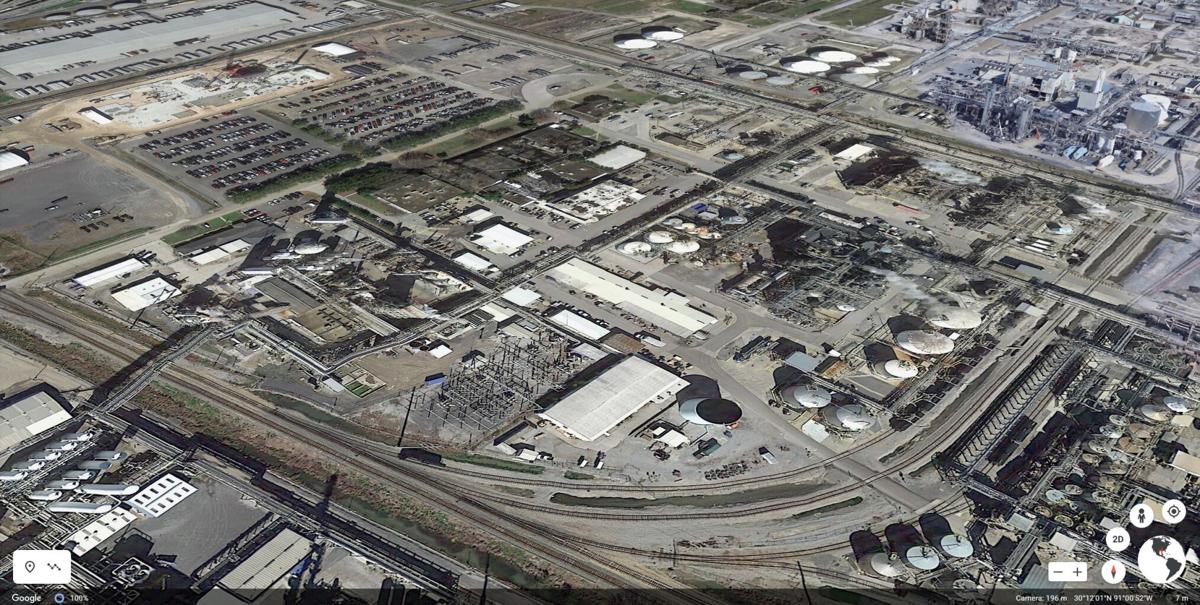
Sandwiched between a half-dozen other petrochemical facilities around Geismar, the L-shaped Rubicon campus includes 18 different chemical manufacturing units.
In February, before the pandemic, there were 460 Rubicon employees and about 240 contractor employees there site each day. Its manufacturing units run 24 hours a day, seven days a week.
This map outlining emergency management information for the Rubicon LLC campus was included in a 2018 EPA facility inspection report.
The production processes are complex, with chemicals routed by myriad pipelines to and from holding tanks and individual manufacturing units, where they are transformed into other chemicals by mixing, heating and creating chemical reactions with metals or other catalysts.
Aniline is produced in three manufacturing units and sent to other areas of the Rubicon campus to make other chemicals.
In 2019, the most recent year for which data is available, Rubicon reported to the EPA that it released 23,400 pounds of aniline to the air, and disposed of 4.4 million pounds of aniline in underground injection wells at the site. The latter amount was nearly half of the production-related waste Rubicon reported releasing into the air, land or water at its campus in 2019.
The 2019 waste total of 9.1 million pounds was down about 12% from the previous year, and down by nearly half from the 17.6 million pounds reported in 2004.
According to EPA’s Risk-Screening Environmental Indicators, a model that estimates health risks to nearby populated areas caused by the release of toxic chemicals at levels allowed by their permits, Rubicon was the 15th greatest creator of health risk in Louisiana. It was No. 4 in Geismar, behind BASF, Shell Chemical and Westlake Vinyls.
RSEI takes the weight of chemicals released at company sites and translates it into values that reflect the relative risk to human health.
The small amount of aniline released during the 2012 accident would not have triggered state reporting requirements had it not been for Housley’s exposure and hospitalization.
Rubicon is not alone in notifying the DEQ of numerous releases of chemicals that are later determined to be too small to be reportable. Indeed, in 2017, the DEQ received so many complaints from industry officials about investigations being started into minor incidents that the agency created a working group to review what companies were required to report.
“What we find statewide .. is they report conservatively because to not report is a significant issue,” Algero said. “So oftentimes they will estimate, err on the side of caution, make a report saying they think it’s above reportable quantities.”
The working group included representatives of the Louisiana Chemical Association; Louisiana-Mid-Continent Oil & Gas Association; the Kean Miller law firm, which represents numerous petrochemical and energy firms; and several regulated firms, including Eastman, Entergy, ExxonMobil, Shell and Syngenta. Also on the panel were four representatives of the DEQ and an official with the State Police, which operates the hotline.
The group met 11 times between October 2017 and December 2018, with the DEQ agreeing at the end to allow initial reports to be amended — though the originals must be maintained. Amending the reports meant some follow-up reports were no longer required, Algero said.
The change did not require a change of state regulations, DEQ officials said.
DEQ spokesman Gregory Langley confirmed that none of the group’s meetings were open to members of the public, nor were community leaders or members of the public asked or allowed to participate in any way.
Mark Schleifstein covers the environment and is a leader of the Louisiana Coastal Reporting Team for The Times-Picayune | The New Orleans Advocate. Email: [email protected]. Facebook: Mark Schleifstein and Louisiana Coastal Watch. Twitter: MSchleifstein.


